







Sumitra migrated from Muzaffarpur in Bihar to Delhi in 2005 in search of a better life. Two decades later, she juggles domestic work in her home and outside. She works in five households from 7 am till 2 pm. Once home, does it all over again, cooking and cleaning while taking care of her ailing parents, she told me in October as I was conducting field work among domestic workers in Delhi.
A month later she broke her leg while cleaning a ceiling fan and had to spend Rs 2,000 at a private hospital. Earning around 3,000 per month she pays rent and supports her unemployed husband and the education of her 14-year-old son who barely attends classes regularly since she is unable to pay the school fees on time.
Domestic work in India is unorganised and unregulated, even though it contributes to the country’s economy. According to the policy network Women in Informal Employment: Globalizing and Organizing, or WIEGO, there is no data so far on the exact number of domestic workers in India. The estimates vary from 4.75 million, according to the 2005 National Sample Survey, to over 90 million, going by different sources.
Their grim working and living conditions are well established. In 2007, the National Commission for Enterprises in the Unorganised sector recognised that domestic workers, like others in the informal sector, live and work in precarious conditions without employment contracts, social security, bargaining power or institutional protection.
Even so, in 2025, a committee appointed by the Ministry of Labour and Employment recommended against passing a separate law to protect the rights of domestic workers in India.
Instead, the report relies on the effective implementation of the four labour codes, consolidating 29 labour laws, which were passed in November. This is despite there being no clarity on inclusion of domestic workers in three of the four codes, barring the Code on Social Security, 2020.
The government reiterated this stance in the current session of Parliament, when MP Shobha Dinesh on March 9 asked the Labour Ministry about fixing minimum wages for domestic workers by introducing a national framework. Minister of State for Labour and Employment Shobha Karandlaje cited the Code of Wages, which has subsumed provisions of the Minimum Wages Act.
“The Code on Wages, 2019 empowers both Central and State Governments as appropriate governments to fix, review and revise the minimum rates of wages for the establishments falling under their respective jurisdiction,” the minister told Parliament in her written response.
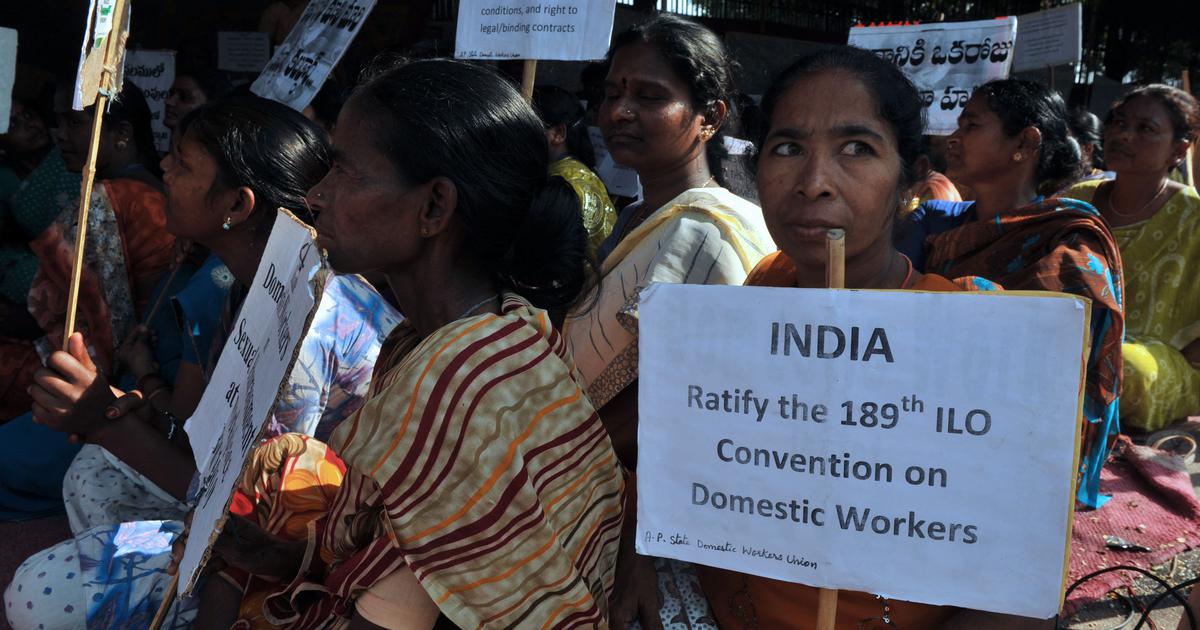
Researchers, activists and domestic worker unions overwhelmingly favour a separate legislation. A law that recognises domestic workers and lays out their rights has been a long-pending demand. Otherwise, employers hold the advantage of dictating terms and conditions without accountability while discriminating on the basis of religion, class, caste and age groups.
By passing such a law, India can recognise the economic value of domestic labour and create a framework that addresses the specific discrimination that domestic workers face and uphold their rights.
Productive care work
Domestic work is understood as a web of inseparable tasks that make human life possible. Feminist scholars describe domestic work as “care work”, since that better captures multifaceted labour which sustains the daily living conditions of basic human health and well-being.
Although domestic work is difficult to quantify, it is productive since it reproduces labour power by enabling adults to work while ensuring that children are raised and prepared to join the workforce. Domestic work is essential to sustaining the economy and communities, contributing indirectly to the gross domestic product of a country.
Since 1959, government and private member bills have sought to regulate domestic work by fixing wages and bringing about registration and social security but none have resulted in a national law.
In 2025, the Supreme Court directed the labour ministry to form a committee to consider drafting a legal framework for the benefit, protection and regulation of rights of domestic workers.
The ongoing plight of domestic workers in India highlights one of the largest yet most invisible segments of our workforce. Most are women from marginalised and economically vulnerable backgrounds who sustain households and enable broader economic participation.
— Congress (@INCIndia) March 23, 2026
Despite their… pic.twitter.com/kVLVFQESnb
Flaws in the committee report
In July, the Martha Farrell Foundation accessed the committee’s report through the Right to Information Act. The report concluded that since various provisions are already in place to protect the domestic workers through welfare policies and legislations, a separate legislation is not needed.
But unions, labour rights activists, researchers and nonprofits condemned the report saying that it failed to reflect the lived realities of domestic workers and reinforces existing exclusions.
The report acknowledges that domestic workers, most of them women, are marginalised due to low wages and weak legal protection, but it fails to examine the depth of the problem.
The four social security codes are adequate, the report notes, even though they define work relationships around formal employer-employee arrangements and institutional workplaces, a framework that excludes most domestic workers.
The report also relies on general welfare schemes like the Pradhan Mantri Matru Vandana Yojana, and laws such as the Child Labour (Prohibition and Regulation) Act, 1986, to protect and ensure the welfare of domestic workers. In response to a question in Parliament in March 2025 on thewelfare of domestic workers, the government had similarly elaborated on its various social security and welfare schemes for “unorganised workers, including domestic workers”.
The report also says that e-shram portal can deliver welfare benefits and redress grievances without any clarity on how it will deal with day to day issues of domestic workers.
The report tells the labour ministry to issue standard operating procedures for state governments to promote the welfare of domestic workers, and talks of strengthening the welfare boards of states through capacity building of the field officers. These recommendations shift the responsibility of protecting domestic workers to the state governments with the Centre acting as a monitoring body.
Our work gets no respect!- a sentiment echoed by millions of South Asian women migrant domestic workers, who face forced labour, trafficking & abuse.@ILO continues to support safe, dignified & decent working conditions through its Work in Freedom programme.
— ILOAsiaPacific (@ILOAsiaPacific) September 11, 2024
Find out more 👇 pic.twitter.com/hNKMJrjbNf
India’s neighbours show the way
The difficulty in regulating domestic work and enforcing labour standards within the private household is often cited as a justification for legislative inaction. This is framed as a trade-off between the rights of workers and the rights of employers, particularly the right to privacy of the household.
However, the Convention Number 189 of the International Labour Organization makes it clear that decent working conditions for domestic workers and the right to privacy of employers are not mutually exclusive. The Convention explicitly recognises the privacy of the employer’s household under Article 17, while simultaneously safeguarding the right to privacy and dignity of domestic workers under Article 6.
Here, it is the state’s responsibility to take a balanced approach in framing a legislation that protects workers from exploitation without infringing upon household privacy.
India’s neighbours show that this is possible and practical.
Sri Lanka adopted The National Policy for Decent Work in 2006, which refers to domestic workers and commits to “improving legal coverage and enforcement” of domestic workers. Sri Lanka has also ratified the International Labour Organization’s Convention 189. Nepal, through its Labour Act, 2017, formally recognises domestic workers and provides for minimum wages, leave, and social security.
A particularly strong example is the Philippines, which enacted the Domestic Workers Act, 2013 (Batas Kasambahay), a comprehensive law that recognises domestic workers as workers and guarantees minimum wages, written employment contracts, weekly rest days, social security coverage, regulated working hours, protection from abuse and harassment, and accessible grievance redressal mechanisms.
Domestic work can be effectively regulated through legislation that balances competing rights while ensuring dignity, safety, and justice for workers. For India, at this point, political will might be be the only way out.
Piyush Poddar works with the Martha Farrell Foundation where he advocates for the rights of Women Domestic Workers.
